Sign in to your account Sign up
Change language
Expertise and innovation for fences since 1973

The first-class ecommerce for fences, posts and gates
Buy online with just a few clicks and receive the order where you want

In our online store you'll find everything you need for fencing and the garden: chainwire fencing, wire mesh, posts and stays, gates, shading net, plastic meshes, accessories, synthetic lawns, sports equipment.

How to Install a Pedestrian or Driveway Gate on Natural Ground: Complete Guide

At Fenceshop, we know how installing a pedestrian or driveway gate can seem complicated when the ground is not fully prepared, which often happens in DIY installations in agricultural settings or in developing areas. In this guide, we want to walk you through each step, explaining the different stages and the necessary precautions to achieve a solid and lasting result, even when working on natural soil instead of a ready-made concrete base.

Why is Installation on Natural Ground Important?

Most tutorials available online focus on ideal situations, where there’s already a perfectly leveled concrete threshold. However, in the real world of fence installation, you often find yourself working on uneven ground: this could be a farm field, a private garden, or a sports facility under construction. In these cases, not having a solid base means you need to pay special attention both to preparing the ground and choosing the right type of foundation.

Preparing the Ground

First of all, it’s crucial to make the ground as flat as possible. If there are slight slopes or uneven areas, we recommend raking and leveling the area where the gate will be installed. In the case of more pronounced slopes, we refer you to our dedicated guide.

Foundation Choice: Individual Footings or Continuous Threshold?

To fix the posts for the gate, you can choose between two solutions:

  • Individual footings: These are two separate holes (one for each post), filled with concrete. This solution is faster and requires less work in terms of digging and materials. It’s ideal when the gate is not particularly heavy or in low-traffic areas.
  • Continuous threshold: This involves digging a single trench between the two posts, placing reinforcement rods inside, and filling it all with a single concrete pour. This offers greater stability and long-term durability but requires more labor and materials.

The choice depends on the setting and intended use: if the gate is light or installed in an area with little foot traffic, individual footings are sufficient; for heavy-duty use or very large gates, it’s better to go with a continuous threshold.

Step-by-Step Installation Process
  • Gate Preparation: Remove the packaging and assemble all accessories and panels on the ground to clearly visualize the complete set.
  • Positioning in the Footings: Once assembled, lift the gate and place it into the footings or continuous threshold, leaving the necessary clearance.
  • Packing and Alignment: Use wedges or pieces of wood to raise the gate to the desired height, making sure the panels do not touch the ground when opening. Use a spirit level, plumb line, or laser level to get the posts perfectly level both lengthwise and crosswise.
  • Temporary Fixing: Secure the gate in the correct position with supports, wires, and tubes, checking that the panels are well aligned. If the gate has two panels, ensure they’re perfectly aligned at the edges and that the stopper is installed correctly.
  • Concrete Pour: Carefully pour the concrete into the footings or into the continuous threshold, taking care not to move the posts and panels due to the weight. If possible, work with a partner: one keeps the gate steady, the other pours the concrete.
  • Setting Time: Allow the concrete to set for anywhere from 2 to 10 days, depending on weather and temperatures. Make sure it’s perfectly dry before removing the temporary supports.
  • Removing Supports: Once the concrete is hard, remove all wedges, wires, and supports. It’s normal for the gate to shift slightly due to the hinge play.
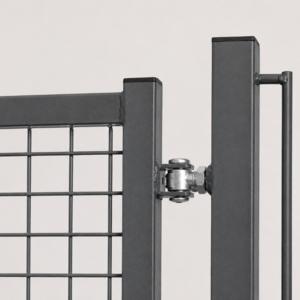
  • Final Adjustment: If the gate is equipped with adjustable hinges, you can easily realign the panels to compensate for ground settling or minor shifts.
Technical Tips and Maintenance
  • Always use footings sized appropriately for the weight and dimension of the gate.
  • Make sure the central stopper (for double gates) is also well concreted in.
  • Adjustable hinges are essential for fixing any future settling, just like with household doors and windows.
Final Considerations

By following these steps, installing a gate on natural ground becomes a task within everyone's reach, even without professional experience. Remember, accuracy during alignment and correct footing sizing are the keys to ensuring your gate’s durability and proper function over time.

At Fenceshop we’re always available to provide advice and quality products for building your fences and gates. For any doubts or further information, feel free to visit our website or contact us directly.

To continue browsing, rotate to landscape your device.
To continue browsing, rotate to portrait your device.
Thanks!
Watch out!

It looks like you are using Internet Explorer, a browser that is no longer supported, as well as unsafe!
We recommend that you continue browsing after downloading the latest version of Chrome or Firefox.