Sign in to your account Sign up
Change language
Expertise and innovation for fences since 1973

The first-class ecommerce for fences, posts and gates
Buy online with just a few clicks and receive the order where you want

In our online store you'll find everything you need for fencing and the garden: chainwire fencing, wire mesh, posts and stays, gates, shading net, plastic meshes, accessories, synthetic lawns, sports equipment.

Designing a tennis court fence correctly requires careful consideration of several elements: fence height, mesh type, post dimensions, foundations, gates and all the accessories that may appear secondary but can make a major difference during installation.

In our new video on the Rete Plastic YouTube channel, we complete our mini-series dedicated to sports fencing, following our guides to 11-a-side and 5-a-side football pitches.

The aim is to approach the project not only from the designer's point of view, but also from that of the installer who will actually build the fence.

How high should a tennis court fence be?

A tennis court fence is subjected to considerably lower impact loads than a football pitch fence. It does not normally have to withstand players hitting the structure or footballs being kicked against it at high speed. Its main purpose is to contain tennis balls and withstand weather conditions.

This means that relatively lighter structures can be used while still providing the required strength and durability.

Typical tennis court fencing is around 3 or 4 metres high. The same height can be maintained around the entire perimeter, or the traditional configuration with lower sections along the sides can be used.

Lower side sections reduce the amount of material required and create a more open appearance. They can be particularly useful in sports centres with several adjacent courts, where the entire facility should be considered as one overall project.

Good fencing starts with the foundations

For a new tennis court, a continuous concrete foundation with holes prepared for the posts is often one of the most practical solutions.

However, the holes should not fit the posts too tightly. Installers need sufficient clearance to adjust the position, alignment and verticality of each post before it is permanently secured.

The depth of the holes must also be suitable for the height of the fence above ground.

When working on an existing facility where a new continuous foundation cannot be built, other fixing solutions can be considered depending on the available substrate.

Correct preparation at this stage can prevent many problems and reduce installation time and costs.

Posts, top rails and braces

Depending on the height of the fence, Ø48 mm or Ø60 mm round posts can be suitable for many tennis court installations.

We recommend hot-dip galvanised posts, particularly for permanent outdoor use, preferably equipped with welded wire rings. These provide a more reliable way of guiding tension wires than simple hooks or improvised fittings.

The structure can be completed with top rails, connecting the posts and improving the overall rigidity of the fence.

Braces are equally important at starting points, corners and gates, where they help withstand the forces generated by the tensioned mesh.

Which mesh should you choose?

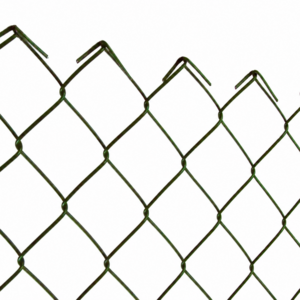
For most tennis courts, galvanised and plastic-coated chain-link mesh remains one of the most practical choices.

It combines durability with flexibility and is well suited to the relatively light impacts generated during tennis.

Rigid welded panels may also be considered for certain projects, while lightweight polyethylene netting can be used for extensions or overhead containment systems where reducing the weight on the upper structure is particularly important.

The mesh must also be properly tensioned using horizontal wires or cables and suitable fittings.

At Fenceshop.eu you can find fencing mesh, posts, top rails, braces and accessories for professional sports fencing projects.

Accessories make a real difference

A complete tennis court fence requires more than posts and mesh.

Tension wires, tensioners, starting and corner collars, tension bars and connection fittings should be considered from the beginning of the project.

Leaving these details until installation often forces the installer to improvise solutions on site.

Using the correct accessories makes installation faster and cleaner and contributes to the long-term durability of the fence.

Gates and court access

Gates should also be designed as part of the overall fencing system.

A common mistake is positioning a gate too close to a corner, without leaving enough space for braces and structural fittings.

Access requirements should consider not only players but also future maintenance of the court.

Gate dimensions, position and opening direction should therefore be decided during the design stage rather than at the end of the project.

Be careful with privacy and wind screens

Privacy and wind screens can significantly change the forces acting on a fence.

Open chain-link mesh allows air to pass through. Once fabric is attached to it, however, the surface can behave much more like a sail.

Wind loads transferred to the posts and foundations can therefore increase considerably.

If screening is planned, it should be taken into account when designing the structure rather than added later without checking whether the fence can support the additional loads.

Design with installation in mind

Many problems encountered during sports fence installation originate from small design mistakes: holes that are too narrow or incorrectly positioned, unsuitable posts, poorly located gates or missing accessories.

A good design should therefore make the installer's work as straightforward and precise as possible.

At Fenceshop.eu you can find mesh, posts, rails, braces, tension wires, collars, gates and other components required to build a tennis court fence.

For more practical advice on tennis court fencing, watch the complete video and subscribe to the Rete Plastic YouTube channel.

To continue browsing, rotate to landscape your device.
To continue browsing, rotate to portrait your device.
Thanks!
Watch out!

It looks like you are using Internet Explorer, a browser that is no longer supported, as well as unsafe!
We recommend that you continue browsing after downloading the latest version of Chrome or Firefox.