Sign in to your account Sign up
Change language
Expertise and innovation for fences since 1973

The first-class ecommerce for fences, posts and gates
Buy online with just a few clicks and receive the order where you want

In our online store you'll find everything you need for fencing and the garden: chainwire fencing, wire mesh, posts and stays, gates, shading net, plastic meshes, accessories, synthetic lawns, sports equipment.

Best Bird Netting for Pigeons: Polyethylene, Cintoflex or Metal Mesh?

Balconies, roof spaces, barns, open sheds and covered structures can become attractive places for pigeons to shelter or nest. One of the most effective ways to prevent access is to install pigeon netting, creating a physical barrier around the area to be protected.

But which type of netting should you choose?

Not all nets have the same characteristics, and some are much more difficult to install than others.

In our new video on the Rete Plastic YouTube channel, we compare three main product families: polyethylene bird netting, Cintoflex polypropylene mesh and metal wire mesh.

The aim is to choose a material that provides effective protection while making installation as straightforward as possible.

Start with the dimensions of the area

Before selecting pigeon netting, consider the size of the opening or surface that needs to be covered.

Large balconies, roof spaces and agricultural buildings often require substantial quantities of netting.

Using narrow rolls can mean creating several joints, each requiring additional fixing work and potentially affecting the finished appearance.

For this reason, it is generally preferable to choose netting available in large widths or made-to-measure sections, reducing the number of joins.

Mesh size is equally important. The openings must be suitable for the birds you want to exclude. Netting intended for pigeons may not be suitable for smaller bird species.

Polyethylene pigeon netting: our preferred solution

For many applications, polyethylene (PE) bird netting offers the best balance between practicality, flexibility and ease of installation.

Its main advantage is its low weight.

Polyethylene netting is easy to gather, carry, position, tension and trim. These characteristics become especially useful when working above ground level or covering large openings.

Different mesh sizes are available, approximately 19 × 19 mm to 50 × 50 mm, depending on the product and intended application.

Colour is another consideration.

Black netting can blend into dark backgrounds, while sand-coloured netting may be more discreet against certain building façades. Transparent nylon alternatives are also available, although they have different material properties.

For outdoor use, always check that the netting is UV-stabilised.

We also recommend considering how the net is manufactured. Knotted netting is often a practical choice because of its flexibility and handling characteristics, provided it is suitable for the application.

Another major advantage is the availability of large net sections, which can significantly reduce installation time.

At Fenceshop.eu, you can explore netting and other outdoor protection products. For certain polyethylene nets, dimensions different from the standard online options may also be available on request.

Cintoflex polypropylene mesh: strong but less flexible

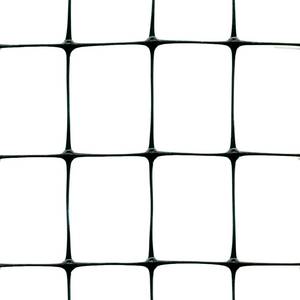
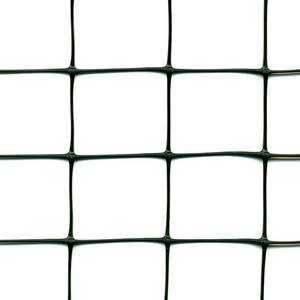
The second option is Cintoflex polypropylene mesh, a robust black plastic mesh available in different mesh patterns.

It can be a suitable material for bird-exclusion projects, but it behaves differently from soft polyethylene netting.

One limitation concerns the available roll widths.

Within the Cintoflex range, the C-Flex and D versions can reach widths of 3 metres, while other types are available in narrower formats.

This matters when covering large openings, because smaller widths may require additional joints.

The second difference is flexibility.

Although Cintoflex can be rolled up, it has a noticeably firmer structure. This makes it less convenient to handle around complicated shapes or in restricted working areas.

It remains a useful option where strength is a priority and the available dimensions match the project.

Metal pigeon mesh: strong but harder to install

The third option is metal wire mesh.

Metal mesh offers excellent strength and can be shaped to suit particular structures. Uncoated metal also behaves differently from plastic netting when exposed to fire.

However, its main disadvantage is the difficulty of installation.

Metal mesh is substantially heavier than polyethylene netting. Depending on the specification, a roll measuring 50 metres long and 2 metres high can weigh around 40 kg.

Handling this amount of material several metres above the ground can be challenging.

Metal wire can also have sharp ends, requires suitable cutting tools and may be difficult to manoeuvre around corners or irregular structures.

For professional installers, it remains a valid solution, particularly where a stronger or more rigid barrier is needed.

For less experienced users, lightweight polyethylene netting is generally much easier to manage.

Which type of netting should you choose?

The best choice depends on the dimensions of the opening, the supporting structure, access conditions and the desired appearance.

The three main options can be summarised as follows:

  • Polyethylene: our preferred option for many installations because it is lightweight, flexible and available in large sections.

  • Cintoflex: strong and practical in suitable applications, but less flexible and with some limitations in available widths.

  • Metal mesh: durable and shapeable, but heavier and more demanding to install.

Whatever material you choose, the perimeter must be secured carefully so that birds cannot enter through gaps.

Before sealing an area, also make sure that no birds, active nests or young birds will be trapped inside.

Choose netting that is practical to install

When purchasing pigeon netting, it is easy to focus entirely on strength and mesh size.

In practice, weight, flexibility, roll width and ease of handling can be just as important, especially on larger installations.

A product that appears suitable on paper may become difficult to work with once installation begins.

This is why polyethylene netting is often our first recommendation: it provides an effective and discreet barrier while keeping installation relatively simple.

Watch the complete comparison on the Rete Plastic YouTube channel, and visit Fenceshop.eu for bird netting, polyethylene netting, Cintoflex mesh and fencing accessories.

To continue browsing, rotate to landscape your device.
To continue browsing, rotate to portrait your device.
Thanks!
Watch out!

It looks like you are using Internet Explorer, a browser that is no longer supported, as well as unsafe!
We recommend that you continue browsing after downloading the latest version of Chrome or Firefox.