Sign in to your account Sign up
Change language
Expertise and innovation for fences since 1973

The first-class ecommerce for fences, posts and gates
Buy online with just a few clicks and receive the order where you want

In our online store you'll find everything you need for fencing and the garden: chainwire fencing, wire mesh, posts and stays, gates, shading net, plastic meshes, accessories, synthetic lawns, sports equipment.

Comprehensive Guide to Installing a Fence for an 11-a-side Football Field

At Fenceshop, with over 50 years of experience in supplying and installing fences for sports facilities, we want to share with you a detailed guide on how to design and build the ideal fence for an 11-a-side football field. Our goal is to help you avoid common mistakes, optimize time and costs, and ensure a high level of technical and functional performance. All the recommendations given are based on our experience and on the materials available in our catalog, which you will also find specified at the end of the guide.

General Information about the Fence of an 11-a-side Football Field

The fence for an 11-a-side football field usually follows the perimeter of the field, which measures about 65 x 105 meters. It should not be mistaken for the playing area itself: the fence serves to enclose and protect the facility, containing balls and ensuring safety for both players and spectators.

The typical structure includes:

  • Perimeter made of metal mesh in the lower part, usually from 0 to 2.20/2.50 m in height.
  • Ball stop extensions behind the goals (ends), made with lightweight polyethylene mesh, which reach up to 6 m in height to contain shots.
  • On the long sides, the height of the fence can remain at about 2.20/2.50 m, while on the ends, extensions are added for extra safety coverage.
Foundations and Preparations

The best solution is to provide for a continuous concrete foundation or a perimeter wall on which to fix the fence. If this is not possible, single concrete footings can be used, always making sure to leave appropriately sized holes for the posts.

  • The holes must be at least 4 cm larger than the diameter of the post (e.g., 60 mm post → 100 mm hole), to allow concrete to be poured around the post.
  • The depth of the holes should be at least 10% of the above-ground post height (e.g., 6 m post → hole at least 60 cm deep).
  • On the ends, the ideal configuration alternates between large holes (for tall posts) and small holes (for shorter posts).
Posts and Brace Arms

The ideal posts for sports facilities are round, for safety reasons:

  • Short posts: 48 or 60 mm in diameter, 2 mm thick.
  • Tall posts: 76 mm diameter, 3 mm thickness, or tapered (76, 100, 120, 150 mm depending on height and position).
  • All posts should be hot-dip galvanized for durability; optionally, they can also be powder-coated.
  • Posts should have wire rings for threading the tension wires or steel cables.

Brace arms are essential, to be installed at the corners and starting points, ensuring the stability of the fence:

  • 48 mm brace arms for short posts, 60 mm for tall posts, with lengths proportional to the height of the post.
  • They can be fixed to concrete footings, walls, or with specific brackets. If necessary, it’s enough to chisel a few centimeters into the wall to fit the brace arm in.
Mesh for Sports Fences

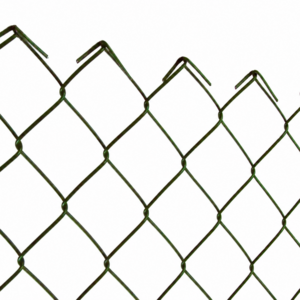
For 11-a-side football fields, we recommend using chain link mesh:

  • Recommended wire diameter: 2.8 mm (for more intensive use, even 4 mm).
  • Galvanized and plastic-coated mesh to ensure quality and durability.
  • For the ball stop extensions: knotted polyethylene mesh, 130x130 mm mesh size, 2.5/3 mm wire, UV-treated and edged.
Wires, Accessories, and Key Details

Accessories are often underestimated but make all the difference for the fence’s performance:

  • On the long sides, coated steel tension wires are sufficient; for heavy mesh or ball stops, a steel cable is essential, especially at the top.
  • Essential accessories: starting and corner collars to connect the brace arms to the posts, rods to be attached to the wire rings for a more aesthetically pleasing and functional finish.
Gates: Placement and Features

Every football field needs at least one 1.20 m pedestrian access gate and one 4 m driveway gate. We recommend:

  • Placing the gates along the long sides, away from the ends and corners, to avoid stress and to ensure you can install the brace arms.
  • Setting the correct gap distances at the foundation stage, following manufacturers’ technical data sheets.
  • Hot-dip galvanized gates, with a handle and lock (preferably a round, accident-preventing knob).
  • Filling preferably in welded mesh.
Tips for Avoiding Common Mistakes
  • Do not place gates right next to the corners or goalposts.
  • Remove PVC pipes used as placeholders in the wall after the concrete sets, to avoid problems when installing the posts.
  • Always check that wire rings are present on the posts; without them, the fence will not be properly aligned or secure.
Conclusions

Carefully designing the fence for an 11-a-side football field means optimizing costs and time while ensuring safety and durability over time. At Fenceshop, we are available to advise you in choosing the most suitable materials and to provide all the accessories you need for a job done right. In our e-commerce, you will find a wide range of mesh, posts, accessories, and gates for sports facilities. To see some of our completed projects, visit the dedicated section on the Rete Plastic corporate website.

We hope this guide has been helpful and invite you to contact us for any doubts or specific requests. Best of luck from the entire Fenceshop team!

To continue browsing, rotate to landscape your device.
To continue browsing, rotate to portrait your device.
Thanks!
Watch out!

It looks like you are using Internet Explorer, a browser that is no longer supported, as well as unsafe!
We recommend that you continue browsing after downloading the latest version of Chrome or Firefox.